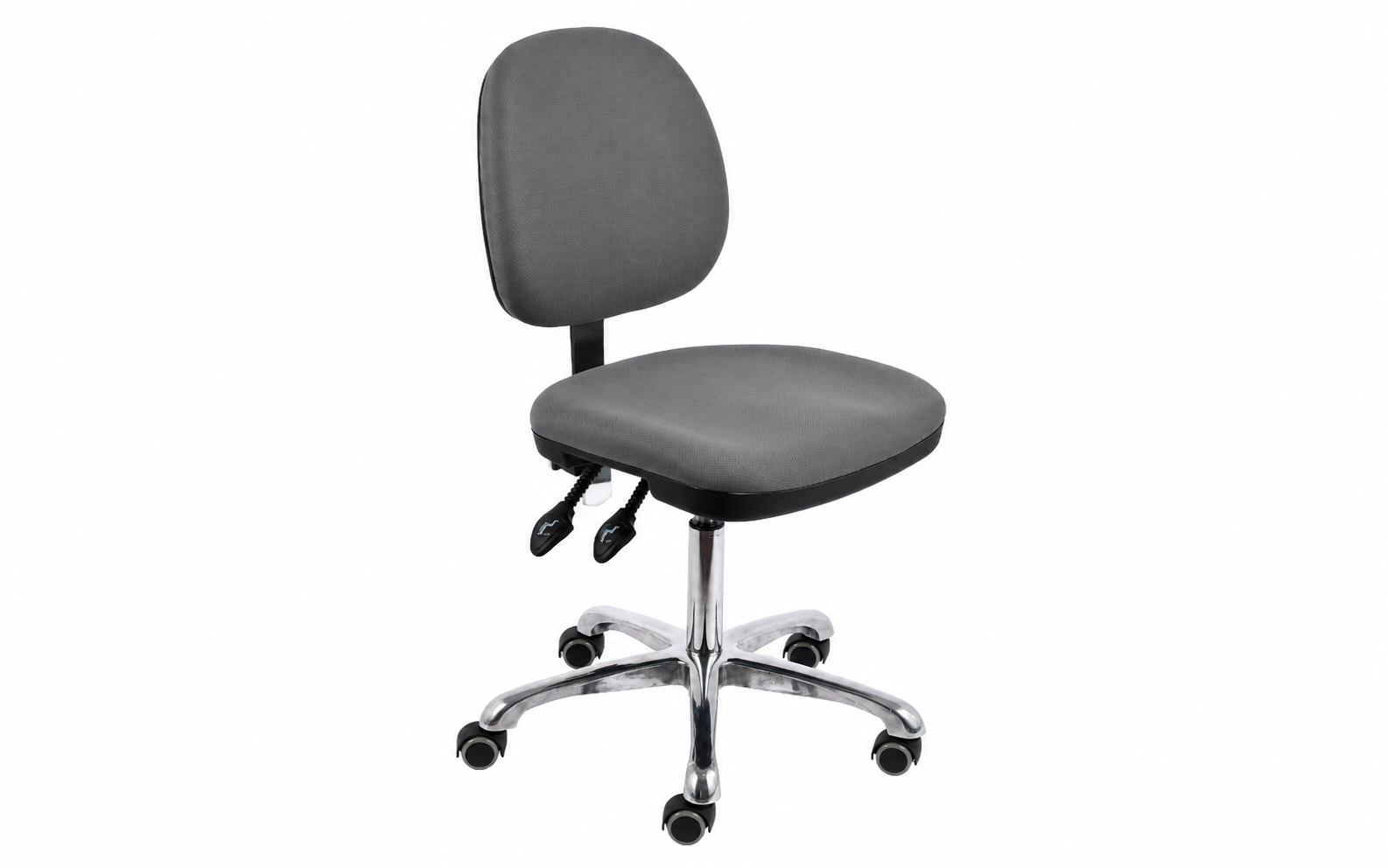
Companies in Argentina can improve laboratory space utilization by treating chair selection as part of layout engineering rather than as a final furniture purchase. In many laboratories, valuable floor area is lost because chairs are wider than necessary, bases interfere with neighboring workstations, seat heights do not match benches, or users must pull chairs far into circulation paths to work comfortably. A better B2B planning process begins with a room-by-room study of bench depth, aisle width, equipment access, user movement, storage locations, emergency routes, and the number of people who may work in the same zone. Procurement teams should record not only how many chairs are required, but also how each chair will move, where it will rest when not in use, and whether one model can serve several users or workstations. When a project is considering an industrial polyurethane with chrome foot ring and casters adjustable laboratory chair, the team should check the base diameter, turning radius, seat-height range, foot-ring clearance, and caster behavior in relation to cabinets, instrument stands, and narrow aisles. A chair that fits the bench correctly allows the user to sit closer to the work surface, reducing unnecessary encroachment into shared space. Adjustable height also allows one chair to support multiple users and different tasks, which can reduce the total number of chairs that must be stored in small rooms. Argentine distributors can strengthen their proposals by providing dimensional drawings, sample units, and simple layout simulations that show how the chair will occupy space during use and when parked. This approach helps laboratories avoid buying too many models, improves workstation consistency, and gives architects, facility managers, and end users a shared basis for approving the final configuration.
Mobility and storage strategy are equally important because the same chair can either improve or disrupt laboratory flow depending on how it is configured. Casters may be valuable in research, quality-control, and teaching environments where users move between instruments, computers, and preparation areas, but uncontrolled rolling can create congestion in tight rooms or reduce stability at precision workstations. Glides or braking casters may be more suitable in zones where the chair should remain in a defined position. For an industrial polyurethane with chrome foot ring and casters adjustable laboratory chair, Argentine buyers should evaluate whether the selected casters suit the flooring, whether the chair can turn without striking nearby equipment, and whether the chrome foot ring adds useful support without increasing the effective footprint beyond the available space. The goal is to create a balanced combination of movement and control. Distributors can help customers segment the laboratory into mobility zones: highly mobile areas, semi-fixed workstations, precision zones, and storage or standby areas. Each zone may require a different base or caster option even when the seat and adjustment system remain standardized. This modular approach allows companies to maintain a consistent product family while adapting mobility to the room, which simplifies spare-parts planning and future expansion. Proper chair selection can also support hot-desking and shared laboratories, where several teams use the same workstations at different times. A chair with a suitable adjustment range can serve more users, reducing duplicate furniture and allowing rooms to support changing project loads. For B2B buyers in Argentina, this creates measurable value because improved space utilization can delay costly renovation, reduce storage needs, and increase the number of productive work points within an existing facility.
The most effective space-utilization strategy combines technical selection with procurement discipline and post-installation review. Before ordering, companies should test a sample in the actual laboratory, measure aisle clearance with the chair occupied, confirm access to drawers and equipment, and observe how users move during normal tasks. The sample test should include different user heights and shift patterns, because a chair that fits one person may create inefficiency for another. If an industrial polyurethane with chrome foot ring and casters adjustable laboratory chair is selected, the acceptance checklist can cover seat-to-bench alignment, parking position, foot-ring clearance, caster control, ease of cleaning, and compatibility with under-bench storage. After installation, facilities and procurement teams should review whether chairs remain inside intended zones, whether circulation routes stay clear, and whether users are moving chairs between rooms. This feedback can reveal opportunities to adjust caster type, reassign models, or refine future quantity estimates. Argentine distributors can use these findings to build original Google-friendly content around laboratory layout planning, chair footprint, bench compatibility, mobile seating, shared workstations, and space-efficient procurement. Such content attracts qualified buyers because it addresses real project constraints rather than repeating generic product claims. Distributors can also offer space-planning support as part of their B2B service, including site measurements, configuration recommendations, pilot layouts, phased delivery, and standardization plans for multiple facilities. For Argentine research institutions, manufacturers, clinics, universities, and testing laboratories, proper chair selection can therefore increase usable space without changing the building. It improves circulation, reduces clutter, supports flexible staffing, and helps each workstation function as intended. By connecting chair dimensions, mobility, adjustability, and storage behavior to the real laboratory layout, companies can make better use of existing space while improving long-term procurement accuracy and operational efficiency.
READ MORE